“Children having treatment for cancer spend so much of their precious childhoods in hospital it’s really important the spaces are inviting, accessible, and a place where they can be children.”
Shona – Cody's Mum.


UCLH treats more than half of all children with cancer receiving radiotherapy in England, making it one of the largest children's radiotherapy centres in Europe. Families travel hundreds of miles because of the expertise of our medical teams, who are among the very best in the world.
But while our clinical care is outstanding, the hospital environment where these children spend so much of their time desperately needs to be updated to reflect the world class care being provided to very sick children.

“Children having treatment for cancer spend so much of their precious childhoods in hospital it’s really important the spaces are inviting, accessible, and a place where they can be children.”
Shona – Cody's Mum.
Radiotherapy is a cancer treatment that uses high-energy rays to damage the DNA of cancer cells so they can’t grow. It’s painless to have, though it can cause side effects afterwards. Doctors carefully plan the treatment with the aim of protecting as much healthy tissue as possible.
Imagine being a child arriving at hospital for radiotherapy. You enter the hospital unit which is underground, with no windows or natural light which is standard across nearly all radiotherapy units due to the equipment. You are surrounded by large, unfamiliar machines and you need to lie still for extended periods of time, sometimes with a mask over your face, or even under general anaesthetic. You have appointments Monday to Friday, every day with each appointment taking an average of 3-4 hours for up to six weeks. This means you are away from your family, your friends and your home.
Children are often separated from their parents during procedures, and while the treatment itself is painless, the whole experience can be overwhelming. Specialists do everything they can to support children through play therapy, reassurance and distraction - but the environment itself is stark, clinical and, in many places, could be more child-friendly.
One recovery room, where children wake after anaesthesia, is a bare space with bright white lights and medical equipment. Parents and staff tell us they wish it could be a warm and reassuring place, but NHS resources can’t stretch to refurbishments.
The playroom, designed to reduce anxiety and help children relax before treatment, hasn’t been updated for ten years. Walls are in desperate need of fresh colour and paint, cupboards need to be updated or repaired, and toys and activities are severely limited. The small isolation room, essential for protecting children with weakened immune systems, urgently needs to be modernised.
For families already going through the most distressing time of their lives, the radiotherapy unit feels unwelcoming and bleak, a space that doesn’t reflect the world-class care and compassion of our staff.
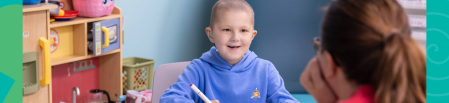
Cody was diagnosed in 2023 with a stage four Germ Cell Tumour. He's had nine different chemotherapy treatments and is currently undergoing six weeks of radiotherapy at UCLH.
Cody’s Mum, Shona told us:
“The treatment, care and staff at UCLH have been brilliant. He actually loves coming in and spending time with Claire, Lead Health Play Specialist, in the playroom, and it’s really important that he looks forward to it. It helps to calm him before treatment.
But the treatment space is very clinical, and the children’s areas need improvements - especially the isolation area where we spent over a week. When he was having a good day, he still wanted to run and play, but we had to spend hours isolated, which was quite difficult.
The playroom needs renovating too. The equipment and toys need updating, and there’s not enough storage. It could look a lot more inviting for children and their carers, especially when you spend so much time waiting for treatment. If it was calmer and more comfortable, it wouldn’t be so hard to spend so many hours here. At the moment, you really rely on the staff to create a positive atmosphere instead of the space itself being relaxing. It would make such a difference if the space felt more exciting and inviting for the children.”
Germ cell tumours develop from special cells that can form many types of tissue. Normally, these cells are important early in human development, but sometimes they grow abnormally and form tumours. These can be benign (non-cancerous) or malignant (cancerous) and may appear in different parts of the body, such as the chest, abdomen, or brain. Treatment usually involves surgery, chemotherapy, and radiotherapy, depending on the tumour’s type, location, and stage.
Research shows that hospital environments have a direct impact on recovery and wellbeing. Children who feels calmer, less anxious, and more at ease cope better with treatment. Creating child-friendly, welcoming spaces can reduce stress, ease fear, and even improve medical outcomes.
Later this year radiotherapy services for children from South London and the South-East of England will be transferred to UCLH, as part of a children’s cancer service transfer from The Royal Marsden Hospital to Evelina Children’s Hospital. This means that the UCLH radiotherapy unit will see all young patients from Great Ormond Street Hospital, Oxford Children’s Hospital, Southampton Children’s Hospital and Evelina Children’s Hospital. Our staff at UCLH are passionate about providing the best care possible for these young patients and tell us that these very poorly children and their carers deserve a much better hospital environment than the NHS budgets can provide.

As a Play Specialist, I know how important friendly and comfortable play spaces are. They bring normality to a child’s time here and help them relax, which makes a huge difference to how they cope with treatment and recovery.
A welcoming environment makes it easier for us to engage children and help them understand what’s happening through play. It’s much easier to do this in a calm, child-friendly space during long, repeated and difficult treatments.
We also use the area for learning, as many children miss school. Cody spends a lot of time playing here, so it’s vital we have plenty of activities and resources to keep him happy and distracted while waiting for treatment.
Even though we tidy constantly, the space feels cluttered because there’s not enough storage or seating. It would be great to have a gaming area for movies or games, plus more toys and activities for different ages to make the playroom more fun and engaging.
As we are due to treat even more young patients soon, we need to make vital changes to this hospital environment as soon as possible.
It would be great to have a gaming area for movies or games, plus more toys and activities for different ages to make the playroom more fun and engaging.
With your help, we want to completely refurbish the children’s spaces in the radiotherapy unit. Together we can:
Completely transform the recovery room with colour, art, and fixed distraction toys so that children waking from anaesthesia feel safe and reassured.
Refresh the playroom with sensory toys, books, consoles, a chalk wall, and comfortable seating that children can use before treatment.
Rebuild the isolation room into a welcoming and practical space where the most vulnerable young patients can rest safely.
Introduce interactive lighting and technology to bring light, comfort, and distraction into this windowless unit.
Replace broken cupboards and cluttered storage with bright, purpose-built units to make the space welcoming and organised.
This transformative project will cost £150,000 - with your generosity, it’s within reach.

By donating today, you’ll be giving young patients a hospital experience filled with comfort.
£25 could provide new art materials and toys to distract children during treatment.
£100 could help transform the recovery room into a calmer, friendlier place.
£500 could fund sensory equipment and consoles for the playroom.
These are simple changes with a huge impact on a child’s sense of safety, confidence, and wellbeing. A gift of any size will make an enormous difference.
With your support we can turn the radiotherapy unit into a space where children can feel more comfortable, where families feel supported, and where staff can deliver the very best care in surroundings that reflect their expertise.
Please, will you help us transform one of the largest children’s radiotherapy units in the UK into the welcoming, child-friendly space these young people deserve?